
Table of Contents
ToggleAnyone trying to grow indoor plants quickly realizes that a sunny windowsill isn’t always enough. Standard household lighting falls short of the spectrum and intensity plants need to thrive. That’s where LED grow lights come in. Unlike older fluorescent or incandescent setups, modern LED grow lights are energy-efficient, long-lasting, and specifically designed to deliver the wavelengths plants crave. Whether you’re starting seedlings, growing herbs year-round, or keeping tropical houseplants alive through winter, the right LED grow light makes a measurable difference. This guide cuts through the marketing noise and focuses on what actually matters: spectrum, wattage, coverage area, and real-world performance for different plant types.
Key Takeaways
- LED grow lights deliver specific blue (400–500 nm) and red (600–700 nm) wavelengths that indoor plants need for vegetative growth and flowering, unlike standard household lighting which falls short in both spectrum and intensity.
- Match fixture wattage and coverage area to your growing space: seedlings need 20–30 watts, herbs 40–100 watts, and fruiting plants like tomatoes require 150–300 watts for optimal results.
- Prioritize PPFD (photosynthetic photon flux density) ratings over marketing claims like ‘super bright’—reputable LED grow lights specify actual coverage footprints and intensity at 300–1000+ PPFD depending on growth stage.
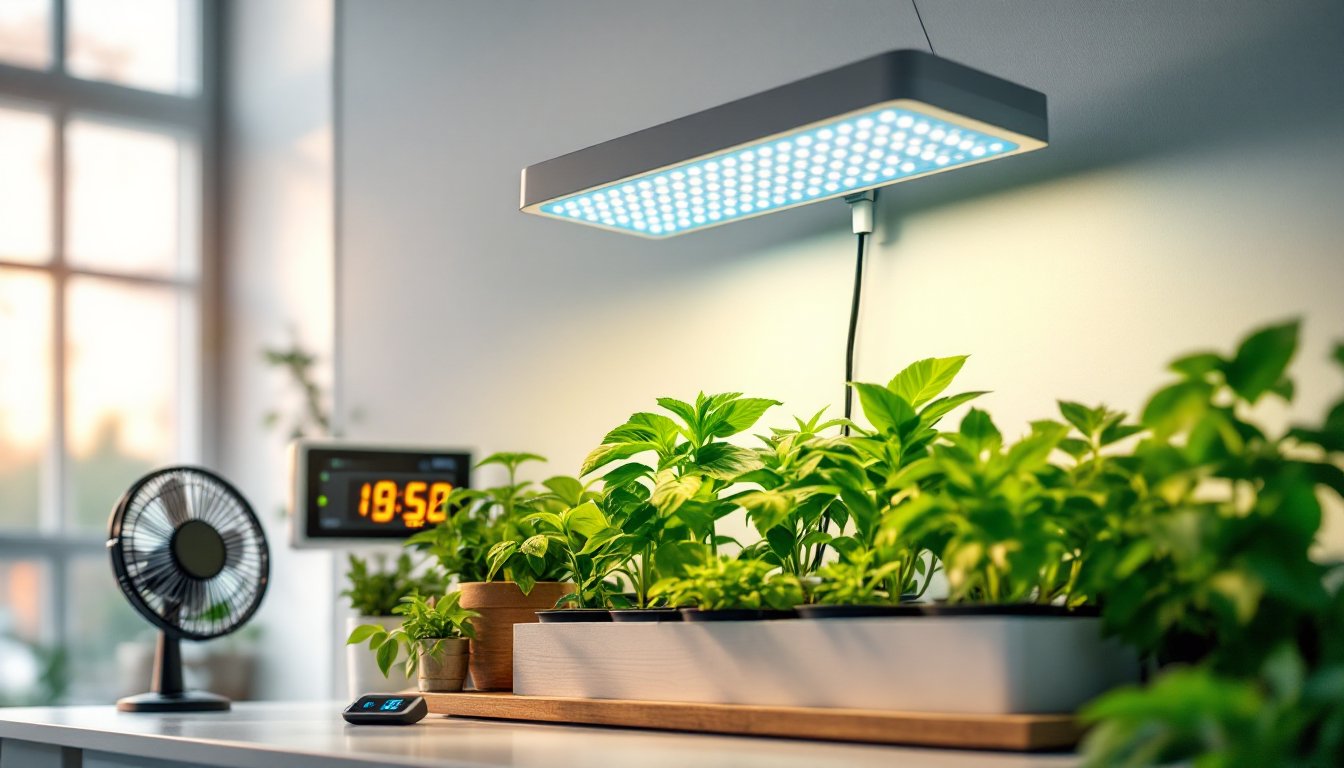
- Avoid common mistakes: position lights 6–8 inches above plants, use a timer for 14–16 hours daily during vegetative growth, provide air circulation with a clip fan, and acclimate plants gradually to intense LED light to prevent shock.
- Choose full-spectrum LED grow lights with both blue and red diodes for flexible, mixed growing; reserve single-spectrum fixtures only for dedicated seedling-only or flowering-only operations to ensure balanced plant development.
Why LED Grow Lights Matter For Indoor Plant Success
Plants evolved under natural sunlight, which spans a full spectrum of wavelengths. Indoor environments, even near windows, deliver light at lower intensity and a narrower spectrum. LED grow lights solve this by emitting specific wavelengths, primarily in the blue range (400–500 nm) for vegetative growth and red range (600–700 nm) for flowering and fruiting. Unlike incandescent bulbs, which waste most energy as heat, LEDs convert 40–50% of their energy directly into usable light. This efficiency translates to lower electricity bills and less heat stress on plants. A tomato seedling or herb garden under proper LED lighting grows faster, stronger, and with more compact foliage than the same plant in low-light conditions. For indoor gardeners, the difference isn’t subtle, it’s the gap between a struggling plant and one that actually produces results.
Key Features To Look For When Choosing LED Grow Lights
Before buying, focus on three core specifications: spectrum, wattage, and coverage area. A cheap fixture with the wrong spectrum wastes money and grows weak plants. Pay attention to how the manufacturer describes output, lumens (brightness to human eyes) is not the same as PPFD (photosynthetic photon flux density), which measures light particles actually useful to plants. Check real-world reviews mentioning plant growth results, not just aesthetics. Verify the fixture includes a way to adjust height, since plants need different light intensity at different growth stages. Finally, confirm the cord length and hanging mechanism fit your space, a light that’s too awkward to position defeats the purpose.
Spectrum And Light Wavelengths Explained
Plants don’t see light the way we do. Blue light (400–500 nm) drives vegetative growth: stronger stems, compact branching, and dark green leaves. Red light (600–700 nm) triggers flowering, fruiting, and root development. Many LEDs are labeled by their color temperature in Kelvins (K), a 5000K light appears white-ish and leans blue, while a 2700K light looks warm and red-orange. For seedlings and leafy greens, aim for 5000K or a spectrum heavy in blue. For flowering plants, fruiting tomatoes, or peppers, favor 2700K or reds. Full-spectrum lights blend both blue and red to handle multiple growth stages, a practical choice if you’re rotating different plants through your setup.
Wattage And Coverage Area Considerations
Wattage tells you energy consumption, but it’s not a direct measure of growing power, efficiency matters far more. A 25-watt efficient LED can outperform an older 100-watt fluorescent. The key is coverage area: a low-wattage fixture thrown at a large tray under-delivers light. Most reputable LED brands specify the footprint (in inches or feet) they’re designed to light at recommended intensity (typically 300–500 PPFD for vegetative growth, 500–1000+ PPFD for flowering). A small seedling mat might need just 20–30 watts: a 4-by-4-foot grow tent could need 400–600 watts of quality LED. Match the fixture wattage to your growing space. Undersizing forces plants too close to the light, risking burn. Oversizing wastes electricity and money.
Top LED Grow Light Options For Different Plant Types
For Seedlings and Leafy Greens: Look for a compact, adjustable T5-style or panel light in the 20–50 watt range with cool white or blue-heavy spectrum. These fit tight spaces and keep seedlings compact without excessive heat. Brands offering models like the Mars Hydro TS600 or similar compact fixtures work well here, though your choice should hinge on your specific footprint and budget.
For Herbs and Houseplants: A dual-spectrum panel (40–100 watts) with both blue and red diodes handles vegetative growth and light flowering (like basil going to seed). These hang over a small table or shelf and cover 2–3 square feet comfortably. Verify adjustable hanging height so you can position the light 12–24 inches above foliage based on intensity recommendations.
For Fruiting Plants (Tomatoes, Peppers): Opt for a higher-wattage fixture (150–300 watts) with strong red output or full spectrum. These plants demand higher light intensity, aim for at least 600 PPFD during flowering. A larger panel or a combination of focused fixtures handles a 3-by-3-foot or 4-by-2-foot growing area. Don’t cheap out here: insufficient light means flowers drop and fruit fails to develop.
For Mixed or Rotational Growing: A mid-range full-spectrum panel (100–200 watts) covers most scenarios if you’re growing different things seasonally. Flexibility is worth the modest extra cost if you’re not committed to a single crop year-round.
Common Mistakes To Avoid When Using LED Grow Lights
Placing lights too close: Even efficient LEDs can burn leaves if mounted within 6–8 inches. Start with the manufacturer’s recommended distance and watch plants for bleaching (white spots on leaves). Back off if you see it.
Ignoring the timer: Plants need a photoperiod, typically 14–16 hours for vegetative growth, 12 hours for flowering. Running lights 24/7 stresses plants and wastes electricity. Use a mechanical or smart timer to maintain a consistent schedule.
Choosing spectrum without purpose: Blue-only or red-only lights are cheap shortcuts that produce weak, unbalanced plants. Spend the extra $20–40 on a fixture with both spectrums unless you’re deliberately running seedlings-only (blue) or flowers-only (red) phases.
Neglecting air circulation: LEDs produce less heat than older fixtures, but stagnant air invites mold and weakens stems. Use a small clip fan to move air gently across plants. This also firms up foliage.
Failing to check PPFD ratings: “1000-watt equivalent” or “super bright” mean nothing. Demand real PPFD numbers or photosynthetic efficiency specs. Marketing hype sells, but plants respond to measurable light quality.
Skipping acclimation: Moving plants from low light to intense LED light causes shock. Gradually increase light duration and intensity over a week. Start at 50% power or 10 hours on, then step up as plants adjust.
Conclusion
LED grow lights have evolved into a practical, affordable tool for any indoor gardener willing to match the right fixture to the right job. The best choice isn’t always the brightest or most expensive, it’s the one that delivers the correct spectrum, coverage, and intensity for your specific plants and space. Start with an honest assessment of what you’re growing, measure your footprint, and prioritize spectrum and PPFD over raw wattage claims. With proper setup and realistic expectations, indoor growing shifts from a frustrating struggle to a genuinely rewarding experience.