
Table of Contents
ToggleIndoor plants add life to any space, but without natural sunlight, they’ll struggle to thrive. Growing plants indoors requires rethinking light, and that’s where indoor grow lights come in. Whether someone’s nurturing a few seedlings on a shelf or setting up a full propagation station, the right indoor light can mean the difference between lush foliage and leggy, pale plants. This guide breaks down the gear that works, how to pick the best option for a specific setup, and how to position lights for real results. Skip the guesswork: let’s get the fundamentals down.
Key Takeaways
- Indoor light for plants is essential because natural windows provide only 1,000–2,500 lux compared to the 10,000–50,000 lux outdoor plants receive, making supplemental lighting necessary for healthy growth.
- LED grow lights are the best choice for most home setups due to their energy efficiency (40–50% conversion), long lifespan (50,000+ hours), and cool operation, unlike fluorescents and HPS alternatives.
- Position indoor light sources 12–24 inches above plants for LEDs and 6–12 inches for fluorescents, following manufacturer PPFD charts to avoid light burn while ensuring adequate photosynthesis.
- Light duration depends on plant type: high-light crops need 14–16 hours daily, leafy greens need 12–14 hours, and low-light houseplants thrive on 8–12 hours, best controlled with an inexpensive timer.
- Choose your indoor light based on coverage area and plant needs rather than wattage alone—a 60-watt LED panel covers approximately 3×3 feet, and many provide adjustable spectra for different growth stages.
Why Indoor Plants Need Artificial Light
Natural sunlight from a south-facing window might seem enough, but it often isn’t. Outdoor full sun delivers 10,000–50,000 lux depending on season and location. Even a bright indoor window provides only 1,000–2,500 lux, not nearly enough for most houseplants, seedlings, or vegetables.
Plants use light energy to photosynthesize, and insufficient light triggers weak growth, smaller leaves, and that stretched, leggy appearance where stems shoot upward searching for brighter conditions. Low-light plants (pothos, snake plant, ZZ) tolerate less, but even shade-tolerant varieties perform better with supplemental lighting.
Indoor grow lights solve this problem by delivering consistent, directional light at the right spectrum, red and blue wavelengths that plants actually use. A setup doesn’t need to mimic perfect outdoor conditions: it just needs to provide enough light intensity and daily duration for the specific plants.
Types of Indoor Grow Lights Explained
LED Grow Lights: Energy-Efficient and Versatile
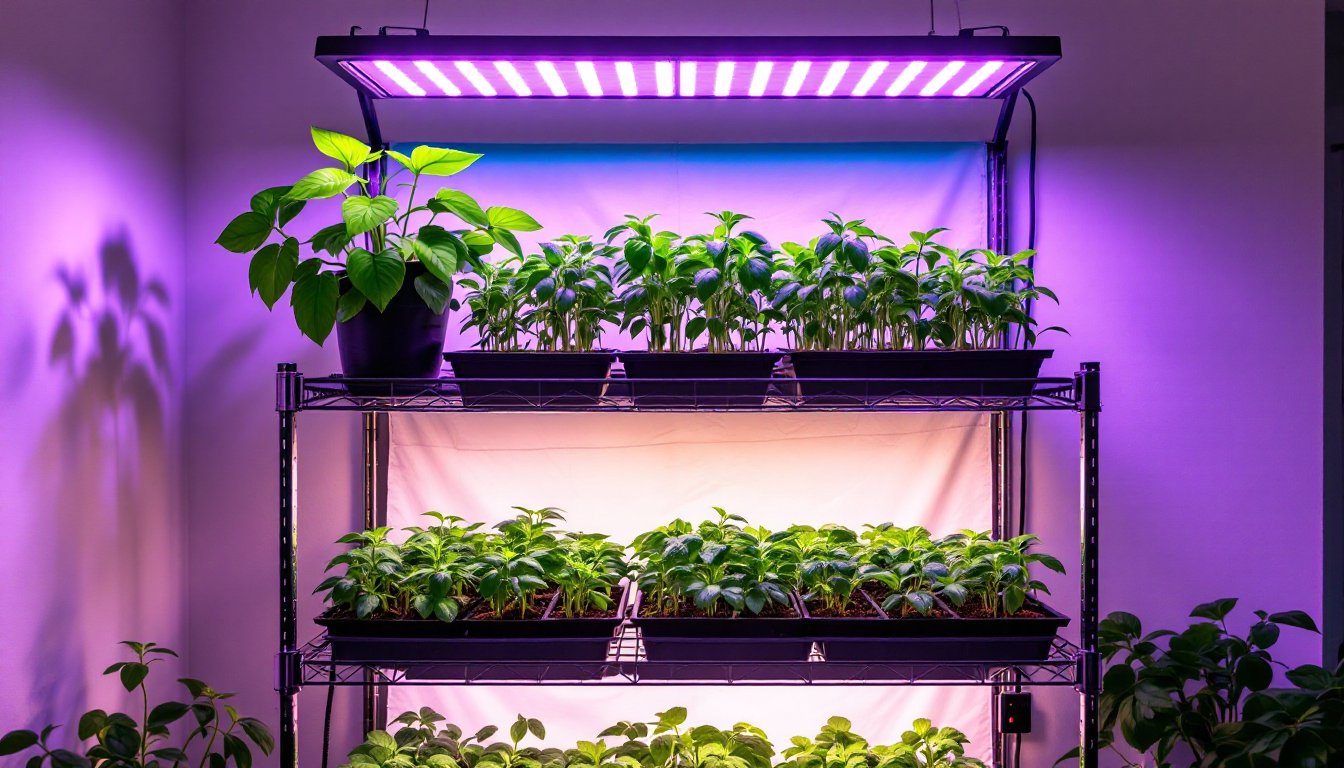
LED grow lights have become the standard for indoor growing, and for good reason. They’re efficient (converting 40–50% of energy into usable light versus 5–10% for incandescent), run cool enough to position close to plants without burning foliage, and last 50,000+ hours. Most are full-spectrum, meaning they blend red and blue wavelengths, the two critical colors for photosynthesis.
LEDs come in several styles. Panel lights (flat rectangular boards) distribute light evenly across a large area, ideal for shelving units or propagation trays. Tube lights (T8 or T12 replacements) work in standard shop fixtures and suit seedling setups. Clip lamps clamp to shelves or stands and focus light on individual plants: they’re portable and affordable but cover less area.
Look for lights labeled “full-spectrum” or with a color temperature of 5,000–6,500K for vegetative growth (leafy plants, seedlings). For flowering or fruiting plants, shift toward warmer reds (2,700–3,000K). Many modern LEDs let users adjust or switch spectra, offering flexibility as plants grow through different stages.
Fluorescent and HPS Options
Fluorescent lights (CFL and T5/T8 tubes) are cheaper upfront and work for low-intensity applications like propagation or low-light houseplants. They’re less efficient than LEDs and run hotter, requiring more careful positioning to avoid leaf burn. T5 high-output (HO) fluorescents are the strongest fluorescent option and remain popular in commercial nurseries.
High-pressure sodium (HPS) lights are traditional in serious growers’ arsenals, they’re powerful (up to 1,200 watts) and excellent for flowering plants. But, they consume significant energy, generate substantial heat, and need ventilation. For a bedroom shelf or small apartment setup, HPS is overkill and impractical. LEDs or fluorescents suit most home scenarios better.
How to Choose the Right Light for Your Plants
Start with the plant’s needs. Seedlings, tomatoes, basil, and peppers are high-light crops requiring 14–16 hours daily and 400–800 micromoles per square meter per second (μmol/m²/s), a measurement called photosynthetic photon flux density (PPFD). Leafy greens (lettuce, spinach, arugula) need moderate light: 200–400 μmol/m²/s for 12–14 hours. Low-light houseplants (pothos, philodendron) get by on 100–200 μmol/m²/s for 8–10 hours.
Next, measure the coverage area. A 60-watt LED panel covers roughly 3×3 feet at adequate intensity: larger setups need proportionally more fixtures. Check the manufacturer’s specs for PPFD at a given distance, responsible makers provide this data. Budget also matters: LEDs cost more upfront but save on electricity and rarely need replacement: fluorescents are cheaper initially but have higher operating costs.
For a beginner’s mixed houseplant shelf, a simple LED panel or clip-on tube light positioned 12–18 inches above foliage works fine. For serious food production (microgreens, seedlings, herbs), invest in a quality LED panel with adjustable spectra and known PPFD ratings. Don’t just chase wattage, two 50-watt LEDs with different designs deliver vastly different light quality, so read reviews and specs before buying.
Optimal Placement and Duration Guidelines
Light distance matters enormously. Too far, and plants don’t get enough energy: too close, and foliage can bleach or burn, especially under intense LEDs. As a starting point, position LEDs 12–24 inches above plant canopy, depending on wattage and PPFD specifications. Fluorescents tolerate closer placement (6–12 inches) since they’re cooler and less intense. Most LED manufacturers provide distance-to-PPFD charts: follow them.
Daily light duration is equally important. Plants don’t need continuous light, in fact, they need darkness for respiration and proper growth signaling. Seedlings and high-light crops: 14–16 hours on, 8–10 hours off. Leafy greens: 12–14 hours on, 10–12 hours off. Low-light houseplants: 8–12 hours on, rest off. Use an inexpensive plug-in timer (around $10–20) to automate this: it removes guesswork and saves energy by preventing accidental all-night operation.
Rotate plants weekly if using a single small light source, it ensures even growth. If setting up multiple fixtures over a shelf or table, spread them evenly and allow 12–18 inches between rows to minimize shading. Reflective surfaces (white walls, mylar film, or aluminum foil lining a growing area) bounce light back, improving efficiency without buying extra fixtures.
Conclusion
Indoor grow lights aren’t luxury items, they’re practical tools that unlock year-round growing in any home. LEDs are the smart default for energy savings, cool operation, and longevity. Pick a light suited to the plants’ needs, position it at the right distance, set a timer, and monitor growth. With consistent, correct lighting, indoor plants don’t just survive, they genuinely flourish.